Showing posts with label Inspiration. Show all posts

UNIT X- Craft Fair 19/04/13

During the previous project I was exploring the relationship between hard and soft materials which resulted in using the laser cutter, wood and thread. I wanted to further my practise and explore this concept as I felt that there was more to discover and evolve within this idea. From the National Trust online archive I discovered some painted wooden floorboards that were inspired by Kelim rugs, which are tapestry woven rugs originating from the Middle East. I was drawn to these items by the bold painted colours combined with the natural colour of the wood.


However they were limiting my drawing and research as there was already an established pattern and colour palette to use. I decided to go back to the origins on wood, so I visited Stowe a National Trust property near Buckingham and took some interesting photos of the site including some of trees that focused on the texture, colour and pattern. From the images I have drawn and started to make small samples to portray the essence of the images and encourage people to look closer and appreciate our natural surroundings.


I am focusing my work for placement within the GNNCF, with a focus on an interiors based product and basing my ideas on the inception and heritage of the National Trust. From the research I have carried out so far I plan on experimenting further by using different substrates (such as paper and wood) combined with thread to further my knowledge of these materials. I will explore different textures, patterns and colours. I do not currently know what the final outcome of the project will be, but I envisage that it will be a wall based piece suitable for the market at the GNNCF.

The professional lectures have been very useful and have strongly encouraged me to think about the professional world in which my practice will sit.  The main point that I have recognised from the lectures is that you have to put yourself and your work out there in order for it to be recognised, it will not happen by itself. Manifold studio portrayed how being part of a studio can have many benefits such as sharing equipment, costs and logistics of running a studio. Furthermore they have the chance to promote themselves through the studio as well as their individual selves thus expanding on the exposure of their practice. Alice Kettle advised us to ‘have faith in yourself and your work’, this advice from such a well-established textile artist is definitely a value I am going to try and maintain. Alice’s talk also reaffirmed that my work is best suited to sit within the field of gallery based work and commissions.

I received some vital feedback from my tutorial; the main point was that I need to have a greater connection to the National Trust, as the photos I took could have been taken in any outside area. I have begun to research further into  the facts and figures surrounding  the National Trust and the placement and location of  properties. 

Locating- Christo and Jeanne-Claude

I have looked at the work of Christo and Jeanne-Claude as the scale of their work varies dramatically. Although the final pieces of their work are on a huge scale, their preparatory studies which they then sell to fund the larger projects are on a far smaller scale, such as drawings and layout plans. This variety of scale is something I need to pay attention to as the Geoffrey Manton building is on a large scale but I will have to scale down my ideas for the Urban Outfitters brief. I like the idea of using my  samples as a finish piece, which in effect is what Christo and Jeanne-Claude do.


 Drawing and plans of how their envisage the 'Surrounded Islands' project to look like.

  Final outcome of 'Surrounded Islands' project in Miami where 11 islands were surrounded by pink floating woven polypropylene fabric. 

Locating- Artist Inspiration


I am working with the idea of designing a piece that will be interiors based. I want to carry on my ideas from the last project but take these further, by finding a way to take thread off a surface.I have looked at artists whose work is focused on thread and how it can be manipulated and translated. Thread is material that everyone can relate to but when put in these contexts in completely changes what most people see thread as, a practical material. The artists are also showing their work in interiors, either in a public space or a gallery. 


Gabriel Dawes is a Mexican artist who creates large scale thread installations and challenges the perceptions of gender roles. A a child he was forbidden to explore the medium of textiles and embroidery. The large scale and geometric outcome of his pieces almost make it appear as though it is not thread he is using but rather 'drawing in the air'. The idea of a what is a line and how can in be shown is space is something I will explore further. 


Amanda McCavour- By using dissolvable fabric a very delicate and translucent surface is created. I like how by using multiples of the same organic shape will create a far more interesting and dramatic piece. The idea of starting with one and using it in multiples to create a larger piece is something that I would like to explore. 


Anne Lindberg thread sculptures redefine the spaces in which they are installed. The space and the architecture plays a large part in the process of creating the pieces. I will need to pay specific attention to the space inside Geoffrey Manton as it is a site specific brief. 


Locating- Inspiration


From the live project options for the Locating unit, I have initially decided to work on the proposal for the Geoffrey Manton building and the proposal for Urban Outfitters on Market Street.  Although very different in terms of scale this will challenge me to think about my work on varying scales and how to fit an idea into a range of spaces.

I have started to base my ideas upon ideas relating to the outlined brief for the Geoffrey Manton commission by relating my ideas to Humanities.  Although only a very vague starting point I am looking at how humans have impacted our plant and what effects it is having on the earth, such as oil spills, deforestation and melting ice caps. 

I found the images of photographer Daniel Beltra incredible. The colours,shape and lines that he captures transforms what is initially a hazard on the environment into a beautiful image in itself. 


http://www.danielbeltra.com/ 

The First Cut Exhibition


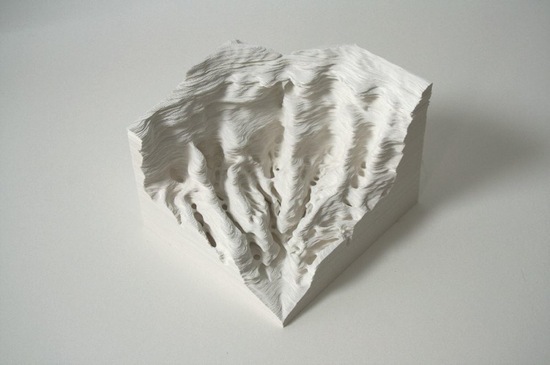
I visited the newly opened exhibition, the First Cut, at Manchester Art Gallery and I was inspired and amazed at the intricacy of a lot of the work. One of my favourite pieces was by Noriko Ambe who cut hundreds of layers of paper to create an undulating surfacing, reminding me of a topography map.  She cuts each piece of paper by hand so that no line is perfect and to achieve subtle differences in each layer representing that nature is in no way flawless.  I like this organic approach that I feel I can apply to my work and let the tools I am working with direct my work, rather than trying to make my pieces appear precise and accurate.


I also had the chance to see Mia Pearlman’s work in the flesh. I love her large scale, free flowing paper cut outs. The shadows produced are amazing and when light shines through the overall effect becomes even more vivid. I especially like how her pieces are not restricted to one wall, but are often spread across the ceiling creating a much more atmospheric look.


Inspiration


I find the work of Ingrid Calame interesting; she simply traces found marks and enlarges them to produce an interesting piece of art. The way that when made into the final pieces they do not look like the marks, but something a lot more abstract appeals to me and is something that I would like try to  bring into my work.  I also like the layering and the simplicity of the line, a quality that could be translated into embroidery in many ways. 


Intentions- Research


For the first project of second year, I have continued looking at similar ideas to that of the summer project, found marks.  I have tried to capture some of the lesser seen marks and lines found in Manchester that often will pass people by. Similarly to my photos of Montenegro, the pictures start to look like maps and aerial views of islands. I have always been drawn to maps. I am inspired by the pattern and colour of the lines and being able to discover about new places.  Since collecting the images I have started to draw and sample, concentrating of the lines, colour and shapes of the images. 


Summer Project


 During the summer I visited Montenegro, a country that I did not know much about, so I decided to base my summer project on this small country. I was staying in a small remote village which had some stunning ageing buildings. I loved the patterns and lines created by the layers of paint that had been painted on top of over the years.  From noticing these shapes I started to notice lots of intriguing shapes throughout the rest of my stay, from lamp posts to marks on the ground. They look like maps and imaginary worlds seen from above, despite being zoomed in images.  The shape of Montenegro is very interesting as it has a long inlet of sea, some of the marks I found almost started to look like the outline of the country.


Mia Pearlman


Having just changed my idea for my final proposal, I saw that Hannah had posted about the artist american Mia Pearlman on the group blog and I really like her work. I feel that it is along the lines of how I envisage my final piece to look if it was to be made. Her paper installations have a similar look to my work in that it is very sculptural and plays with form and I like the draping look to it whilst still being a solid structure. I love how they go from wall to ceiling and onto the floor, something that I will consider for my piece and think could look could in the new building where the walls are very high,a sculptural piece could help to close the space down and make it feel more intimate in areas. 


Room Divider


I have done some more research, as I have decided that it is a room divider that I’d like to propose. I have decided upon this over a blind as I feel that as the new building is so open plan that to be able to make it feel more intimate when need will be very beneficial while still having the feeling of space.

Here are a few more images that are helping me to design and think of ideas for a new room divider. I have chosen these because they split a room up, but are not solid walls which ensures the feeling of space is maintained while still adding the feeling of closing the room down to a smaller space. 

_MG_2036.jpg
I really like the simple graphic pattern created by this room divider by Apartment Therapy, which has been made using old painted vinyls.  
'MOLO' have created a room divider with a honeycomb design that can be easily moved and  stretched up to  4.5 metres. I like the innovative use of cardboard that has been developed to created a simple but elegant design. 


"Brick House" "Rope Wall" Divider
This wall divider, by 'The Brick House' , made using rope cleverly splits the room in two while still keeping the room as one.


Bloomming Design Studio


I have found a company that makes interesting wall dividers amongst other products such as vases, clocks and tables. Bloomming is a Dutch design studio who have created a stainless steel blind/ wall divider whereby the diamond shaped components can be moved and tilted to created varying patterns and allowing patterns to be created by the shadows. I really like this idea as it allows you to change the design and allow different amount of lights to penetrate through. I want to see if I can do something with my ideas to achieve a changing pattern or let different shadows be created. 


My work...

After all the maps and diagrams that I saw at the Cube Gallery, I have continued to use them to draw from. I was initially using only a few maps, but after a tutorial it was clear that I needed a greater variety of maps to work from. I complied a collection from various places, and it has definitely helped me having more to look at. What stood out to me the most from the  maps of Manchester, were the striking bold colours used, something which I intend to use in my work. My ideas have moved on from the original 'Arrivals Task', but I feel that this did help get to where I am now, as the idea of getting lost in the alleyways is related to getting lost on a map and not knowing where to go or where you are.

CUBE Gallery- Alix Dessain

Richard Brooks, a lecturer in Architect, came in to talk to us about the new art school but more specifically about the 4 internal concrete pillars within the building. Rather than being 4 plain pillars they have been moulded with a floral pattern, designed by former Manchester School of Art pupil Lewis Day. By adding the floral pattern the harshness of the grey concrete has been softened and makes the pillars look a lot more attractive and interesting and I’m looking forward to being able to see the pillars myself. It was interesting seeing what is usually considered a very industrial material being used in such a way to give it a softer and more textural look.  
He also spoke about the current exhibition at the Cube Gallery ‘Infra_MANC’ which looks at the post war development of the infrastructure in the city.  I went to see this exhibition and really enjoyed it as I was able to look into the geographical history of the city. I was intrigued by the underground system that is in the city and has made me want to explore this more and incorporate it into my project. The underground world of Manchester that many people don’t know about or even know exists reminded me of the mystery of the alleyways in Marrakech where people don’t know what is around the next corner or what lies on the other side of the alley walls.
Here are a few pictures of detailed maps with patterns and colours that I found interesting and appealed to me.

ARRIVALS TASK- Alix Dessain

To begin the project we were asked to imagine arrving at a place. I decided to look at arriving in Marrakech, Morocco, as when I visited the country last summer there was such a stark contrast to England that I felt and saw as soon as I stepped off the plane, despite only being 3 hours away on the plane.  The biggest difference to me was the colour, arriving from a drab and grey England to a city full of warm shades of oranges, yellows and red was refreshing and gave the city an striking look immediately.
Img_7557
I loved the hustle and bustle that is seen along the street and the alleys within the medina. Anywhere you walk down there is some sort of activity happening, whether its children playing outside their homes, cats running around, a donkey cart pulling oranges along, a motorbike about to run you over, men rushing to the mosque at prayer call, there is always something going in and even late into the night there was still constant activity going on in the alleys.
Img_7153
Marrakech
But this is in complete  contrast to when you enter a riad, a traditional Moroccan house with an internal open-air courtyard. What appears to be a dull, ordinary looking and often suspicious door off a winding alley of the medina opens up into a tranquil surrounding that feels a million miles away from the chaos outside.  Once inside, you feel very calm and content being surrounded by gorgeous coloured tiles, lanterns hanging everywhere and amazing rugs and textiles scattered on the floor. The noise from the alleys and streets is completely hidden and the only sound you can hear from the outside world is the mosque calling the Moroccans to prayer which is heard several times a day from one of the numerous mosques found within the medinas walls. From the rooftop, you can see across all of the roof tops within the medina and the towers of the mosques.
Maroc16
1-5-tile-fountain-riad-salam-hotel-casablanca
Img_1993
Marrakesh was such an exciting place to spend time in, there was so much to look at and admire when I was wandering through the souks and streets that I want to revisit my time here and wish that I was still there!